"It is in the shelter of each other that the people live." -- Irish proverb
How to talk to your child about poverty and homelessness

"What your grade-schooler knows -- and needs to know. Five- to 8-year-olds are transitioning from being me-centered to seeing themselves as part of a group. 'So it's a good time developmentally to talk about hunger and poverty,' says Susan Linn, a child psychologist at Harvard Medical School. They're also becoming interested in doing something about the problems they see. School-age kids will have lots of questions: 'How long will that person live there? Does he have kids?' What your child needs is guidance from you about how to think about the issue. It's key to sort through your own attitudes before bringing it up. Think about how you want your child to respond to the homeless -- and how to explain it in a way that makes sense. Some parents want their children to be cautious around panhandlers; others encourage their kids to be friendly and show compassion." [read more]
Reading Corner
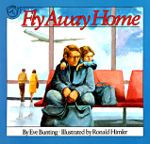
Title: Fly Away Home
By: Eve Bunting Illustrations: Ronald Himler Stages: 5-8
"This is a sensitive book about a boy and his dad who live at the airport. Homelessness is not a common subject for any children's book and a picture book on this small family is a daring deed for Bunting and Himler to attempt. They had to walk a fine line to tell us this story. A misstep in any direction would have brought condescension, over-simplification, false cheerfulness or hopelessness yet Fly Away Home is free of all these things. As with any picture book, it's good to start with the cover. On this one we have the dejected father in an airport waiting area with his son leaning over the seat to drape his arms across his father's shoulders. Both are clean and dressed in plain blue (the boy narrator warns often about the dangers of being noticed.) The father's hands hold a large blue bag and beside him on the seat is a smaller one. We'll learn in the book, that these contain their only possessions. In the background are a man and woman obviously waiting to welcome travelers off the flight that may be arriving even now. Not under strictures to be unnoticed, this couple wears bright colors. To open the book is to get an insight into a counterculture that most of us don't even know exists. The matter of fact narrative by the boy tells us a story of coping with misfortune and homelessness. There is no preaching here, neither does the author/narrator offer a simplistic solution. There is hope here, however. The boy has watched a sparrow trapped inside the airport for days slip out of an open door at the right moment and "Fly away home." We and the boy hope he and his father, as well as the other homeless people in this book, find their opportunity to do the same." -- Reviewed by Carol Hurst's Children's Literature Site
By: Eve Bunting Illustrations: Ronald Himler Stages: 5-8
"This is a sensitive book about a boy and his dad who live at the airport. Homelessness is not a common subject for any children's book and a picture book on this small family is a daring deed for Bunting and Himler to attempt. They had to walk a fine line to tell us this story. A misstep in any direction would have brought condescension, over-simplification, false cheerfulness or hopelessness yet Fly Away Home is free of all these things. As with any picture book, it's good to start with the cover. On this one we have the dejected father in an airport waiting area with his son leaning over the seat to drape his arms across his father's shoulders. Both are clean and dressed in plain blue (the boy narrator warns often about the dangers of being noticed.) The father's hands hold a large blue bag and beside him on the seat is a smaller one. We'll learn in the book, that these contain their only possessions. In the background are a man and woman obviously waiting to welcome travelers off the flight that may be arriving even now. Not under strictures to be unnoticed, this couple wears bright colors. To open the book is to get an insight into a counterculture that most of us don't even know exists. The matter of fact narrative by the boy tells us a story of coping with misfortune and homelessness. There is no preaching here, neither does the author/narrator offer a simplistic solution. There is hope here, however. The boy has watched a sparrow trapped inside the airport for days slip out of an open door at the right moment and "Fly away home." We and the boy hope he and his father, as well as the other homeless people in this book, find their opportunity to do the same." -- Reviewed by Carol Hurst's Children's Literature Site
Recommended by Cubs Editors
Be the Change
In this video clip, some people without homes are given are rare chance to let others know something about themselves, other than the absence of a home. Wonder out loud with your children about what quality, skill or accomplishment they would like others to know about themselves that is not apparent just by looking at them.